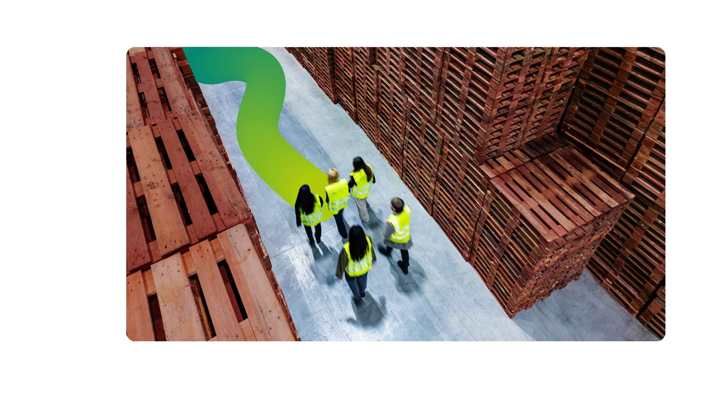

IPP commits to cutting emissions by 2030 and reaching net zero by 2045
At IPP, emissions reduction is a top priority. We are working to cut our Scope 1 and 2 emissions by 42% by 2030, using 2024 as our baseline. These emissions come from things like our buildings and company vehicles. To tackle them, we have started shifting to electric and hybrid vehicles across our fleet.

Smarter Pallet Pooling in Action: Helping Supply Chains Flow Faster
In today’s fast-moving world, businesses need logistics that keep up. At IPP, we believe supply chains should run smoothly, sustainably, and with zero unnecessary steps. That’s why we’ve partnered with three of Spain’s top retailers to make pallet flows faster, smarter, and more efficient.

Inside IPP’s Sustainability Strategy: How We Build Impact Through Circularity
IPP’s approach to sustainability is more than a set of goals. It is a structured, group-aligned strategy built on data, action and collaboration. As part of Faber Group, we are working to become Europe’s most sustainable pallet pooling partner, and the digital leader in load carrier pooling and logistics optimization.

With IPP, the Loop Is Always Closed — Because We Never Let Go
Under the EU’s new Packaging and Packaging Waste Regulation (PPWR), producers manufacturers are expected to take full responsibility for the lifecycle of their packaging. At IPP, we’ve built our entire model around that principle—from the beginning. In our closed-loop pooling system, IPP retains legal ownership of every pallet we put into circulation. That means we don’t just deliver packaging—we manage it. We maintain it. And we bring it back. Ownership ensures responsibility, and with IPP, that responsibility never leaves the loop.
Report reveals sustainability progress of pallet pooler
The latest sustainability report from a leading European pallet pooling specialist reveals a collective saving of more than 40,000 tonnes of CO₂ emissions - the equivalent of 177 million miles of driving.

From regulation to real impact: how reusable pallets support circular supply chains across Europe.
In 2022, the EU generated an estimated 186.5 kg of packaging waste per person. To address this, the Packaging and Packaging Waste Regulation (PPWR) is setting a bold new course for how packaging should be designed, used, and recovered.